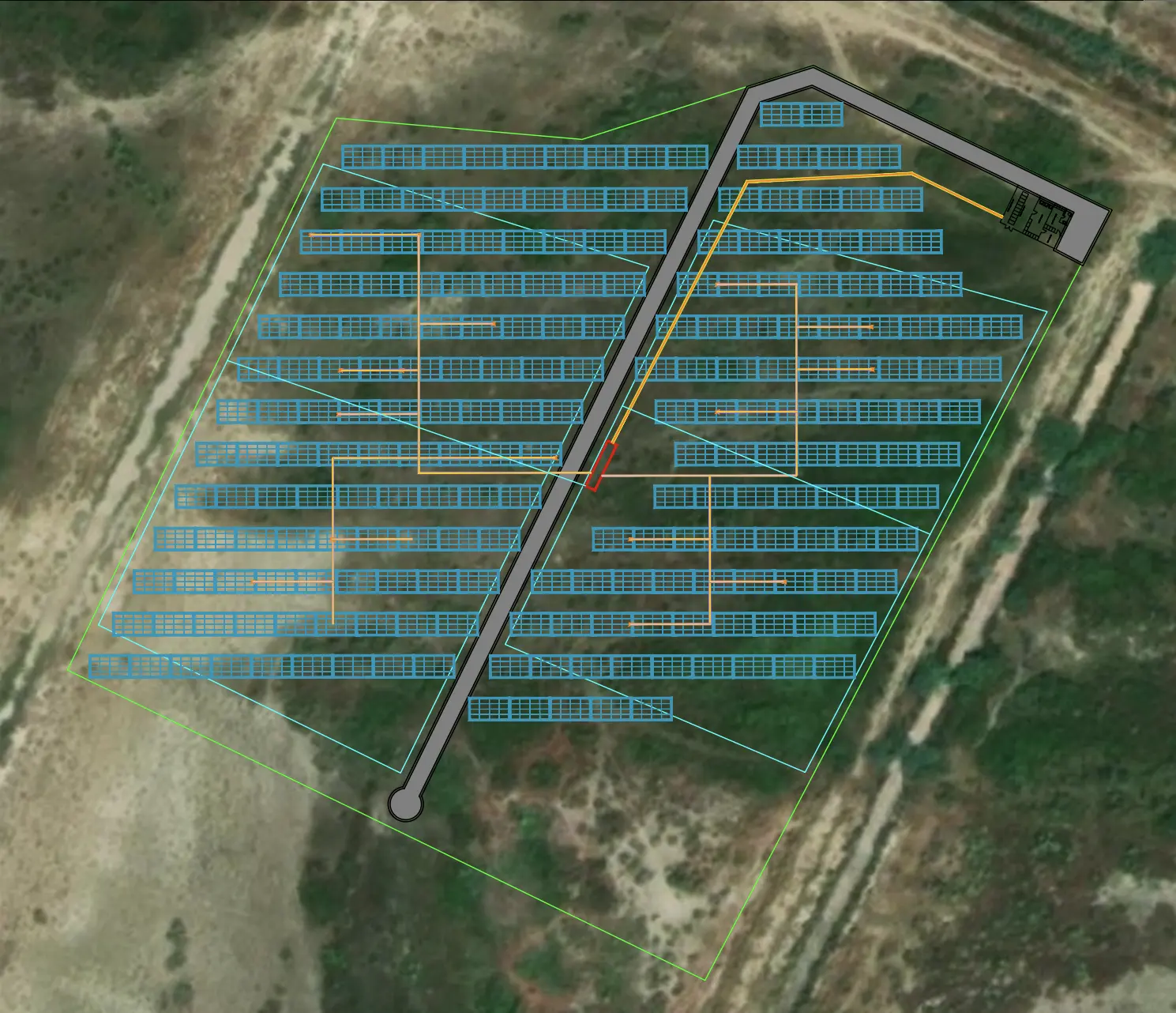
The “Fier Renew” photovoltaic (PV) project is a utility-scale solar power installation developed in the Fier region of Albania, designed to contribute to the country’s renewable energy targets and diversification of energy sources in line with national and European energy policies. The project is based on detailed technical and climatic assessments, incorporating Meteonorm 8.0 data to ensure accurate solar resource evaluation, with an annual global horizontal irradiation (GHI) of approximately 1552 kWh/m².
The primary objective of the project is to generate clean electricity through a grid-connected PV system with an installed capacity of approximately 2 MW. The plant is designed to operate under a medium voltage network of 20 kV, ensuring efficient transmission and integration into the national grid. The system design adheres to international standards, including IEC regulations for electrical installations and cable sizing, ensuring safety, reliability, and minimized energy losses.
The PV array consists of high-efficiency monocrystalline modules (Trina Solar TSM-DE18M II 670 W), optimized for performance under varying temperature conditions. The mounting structure is a fixed-tilt metallic support system anchored into the ground with driven piles, designed to withstand environmental loads and ensure long-term structural stability. The layout has been optimized considering ground coverage ratio (GCR), shading losses, and land utilization.
Environmental considerations include minimal land disturbance, optimized spacing for reduced shading, and system efficiency over its lifecycle. Module degradation has been accounted for, with performance expected to decrease gradually over 30 years. Auxiliary consumption and system losses have been incorporated into the production model to ensure realistic energy yield estimates.
The project is expected to operate with high availability, supported by monitoring, security systems, and scheduled maintenance, ensuring sustainable energy production throughout its lifecycle.