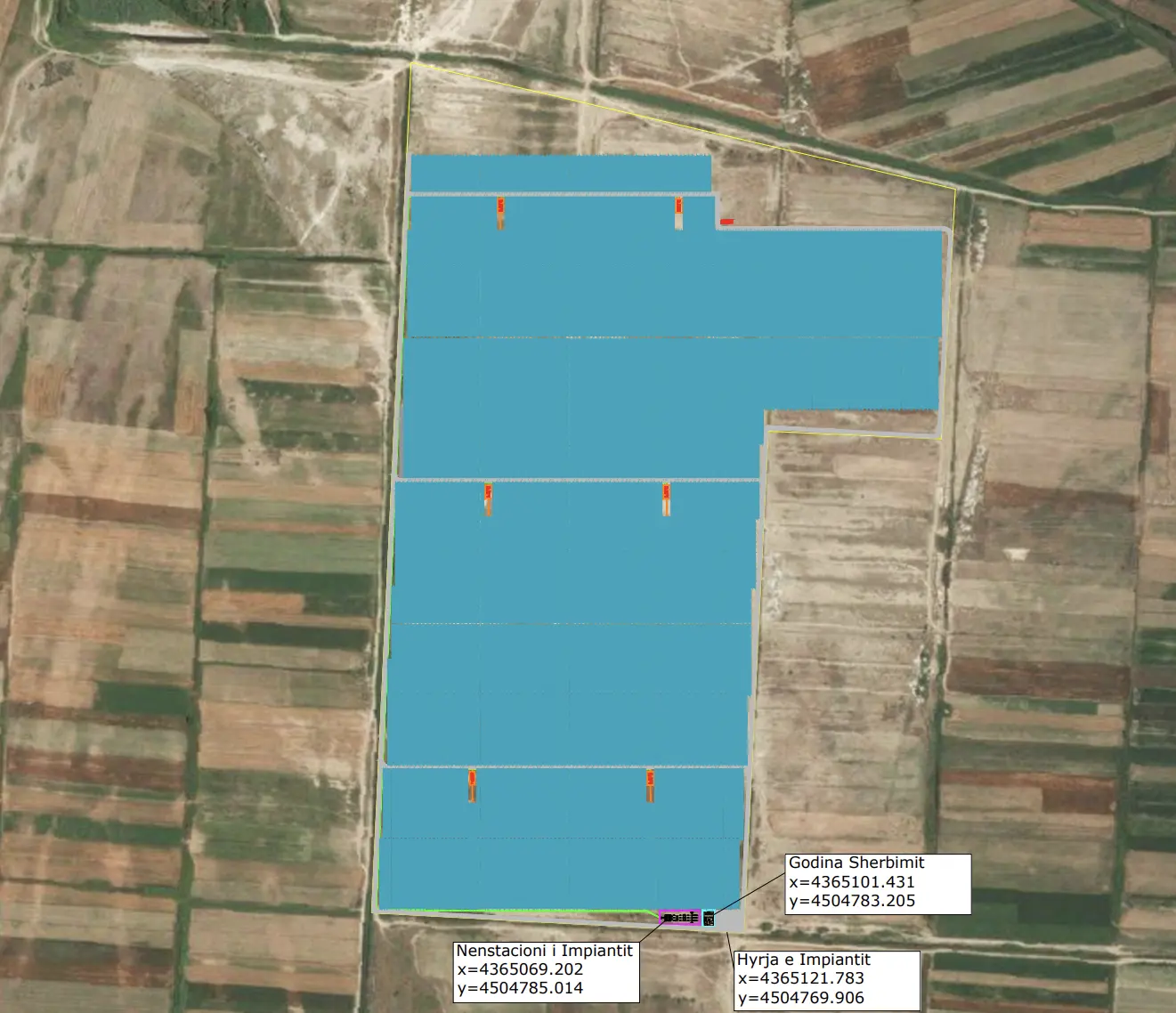
The project consists of the development and grid integration of a utility-scale photovoltaic (PV) power plant with an installed capacity of approximately 38.9 MWp, located in Bashkim village within the Fier Municipality, Albania. The project is designed in accordance with Albanian energy regulations and grid code requirements, supporting the country’s transition toward renewable energy generation and reduction of carbon emissions.
The plant is situated on relatively flat terrain covering approximately 40 hectares, enabling optimal layout and efficient installation of tracking systems. Solar resource assessment has been conducted using long-term satellite datasets (Meteonorm, PVGIS, and NASA-SSE), ensuring reliable estimation of solar irradiation and energy yield over multi-year periods.
The system incorporates high-efficiency bifacial monocrystalline photovoltaic modules (Trina Solar Vertex series) mounted on horizontal single-axis tracking structures, enhancing energy production through improved solar capture. The total installed DC capacity reaches approximately 38.92 MWp, while the AC output is rated at 34.38 MW. Energy conversion is achieved via 11 central inverters, with power evacuated through a dedicated 110 kV transmission line connected to the national grid via the Kafaraj substation.
Electrical infrastructure includes underground medium-voltage cable networks, string boxes with surge protection, and a step-up transformer system (20/110 kV). The project also incorporates monitoring and control systems for performance optimization and operational reliability.
Environmental considerations include minimal land disturbance, optimized land-use efficiency through tracker spacing (GCR optimization), and provisions for site rehabilitation. The plant is designed for a lifecycle exceeding 25 years, accounting for module degradation and maintenance strategies to ensure long-term performance and grid stability.