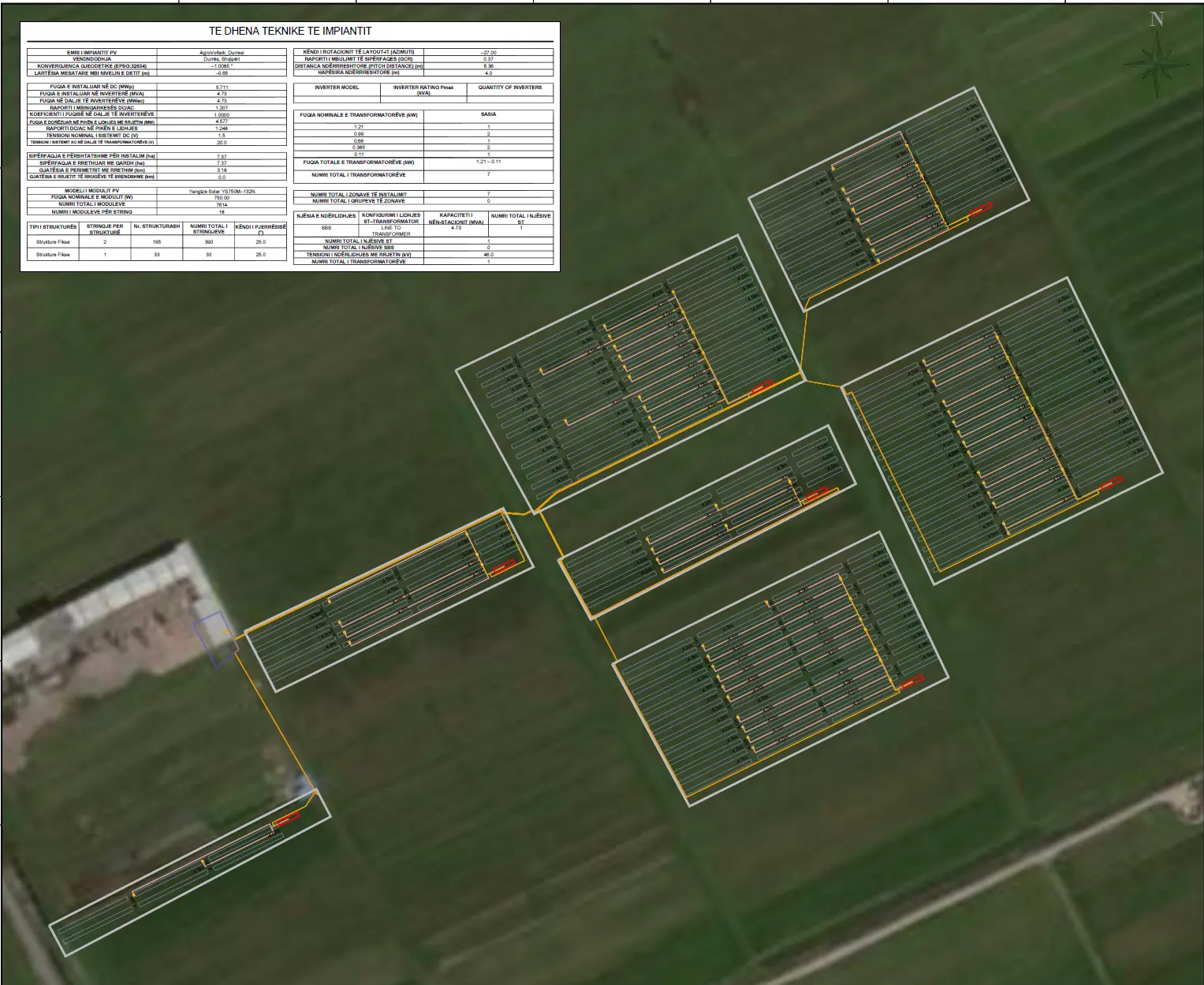
The “ALBSOLAR PARK 2” Agrivoltaic Solar Power Plant is an integrated renewable-energy and agricultural development located in Bisht-Kamëz, within the Katund i Ri Administrative Unit of the Municipality of Durrës, Albania. The project is being developed by ALBSOLAR sh.p.k. and combines utility-scale photovoltaic electricity generation with the continued productive use of agricultural land.
The consolidated technical configuration comprises an installed capacity of 5.7105 MWp DC and 4.73 MW AC, distributed across seven technical areas. The photovoltaic field includes 7,614 high-efficiency 750 Wp modules, connected through 86 string inverters and seven energy stations. Electricity is collected through a 20 kV internal medium-voltage network and evacuated through a dedicated 46/20 kV substation equipped with a 5 MVA power transformer.
The photovoltaic modules are installed on raised, fixed-tilt steel structures designed specifically for agrivoltaic operation. The selected configuration provides a minimum clear height of 3.00 m, a row pitch of 6.36 m, and functional agricultural corridors of at least 4.00 m, allowing access for tractors, mowing equipment, irrigation maintenance and agricultural operations. The physical module coverage is approximately 32.5%, remaining below the applicable 40% land-coverage threshold.
The agricultural component is based on the cultivation of alfalfa (Medicago sativa), selected as a perennial forage crop suitable for repeated mechanized harvesting and for improving soil structure and nitrogen balance. Approximately 45,354 m², equivalent to 62.33% of the cadastral project area, is retained as net agricultural and cultivable land. The agronomic plan targets a dry-matter yield of approximately 15 t/ha/year, with several cuts per year and an estimated annual production of approximately 68 t of forage.
Due to the low-lying coastal setting, the project incorporates dedicated soil, irrigation and drainage measures. These include the rehabilitation of existing drainage channels, control of soil salinity and waterlogging, sectorized irrigation, monitoring of soil moisture and electrical conductivity, and management of agricultural traffic to limit soil compaction. A PAR/PPFD light-monitoring programme is also included to assess light distribution beneath the photovoltaic structures and compare crop performance with a dedicated control area.
The plant’s estimated first-year energy production is approximately 8.61 GWh, with a specific production of approximately 1,508 kWh/kWp, a Performance Ratio of 79.57%, and an estimated capacity factor of 20.78%. The project is designed for a technical operating life of approximately 25–30 years, with photovoltaic degradation and long-term agricultural monitoring incorporated into the operational framework.