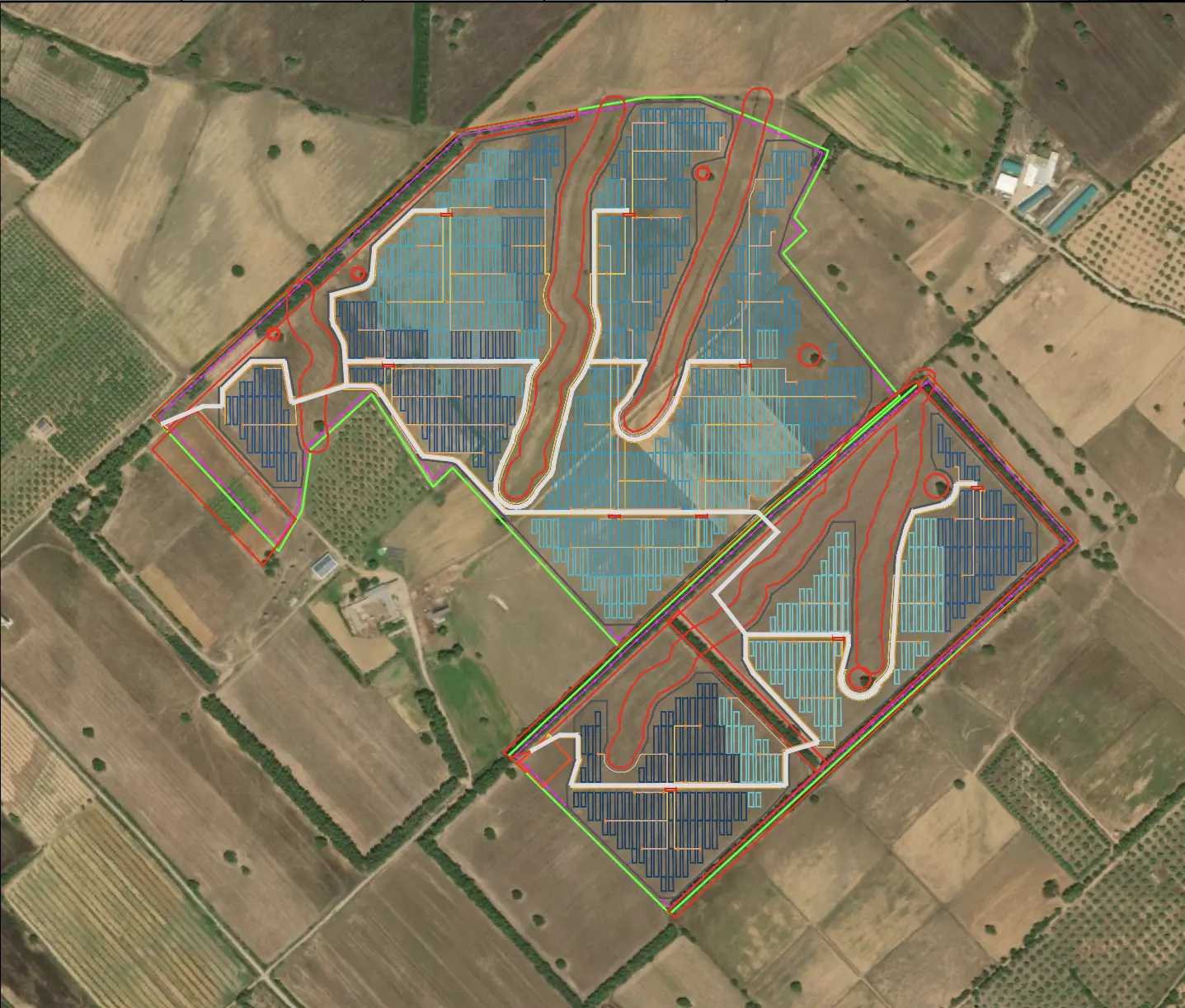
The PVPP EG ATLANTE project is a utility-scale, grid-connected photovoltaic power plant with an installed DC capacity of approximately 24.57 MWp, located within the municipalities of Gonnosfanadiga and Guspini in the Sardinia Region of Italy.
The project has been designed using a single-axis tracking system with backtracking, allowing the photovoltaic modules to follow the daily solar trajectory while controlling inter-row shading. The plant configuration incorporates bifacial photovoltaic technology, which enables additional energy production from solar irradiation reflected onto the rear side of the modules.
The photovoltaic field consists of 40,274 LONGi Solar LR7-72HGD-610M modules, each rated at 610 Wp. The modules are arranged in 1,549 strings of 26 modules, installed on approximately 852 tracker structures. The tracker layout uses an indicative pitch of 8.00 m, a collector width of approximately 5.07 m and a modeled ground coverage ratio of approximately 63.4%. The tracker axis is positioned approximately 2.50 m above ground level.
According to the PVsyst design variant, the DC energy is converted through 19 Sungrow SG1100UD central inverters, providing an aggregate nominal inverter capacity of approximately 20.90 MWac. The modeled grid injection capacity is limited to 19.80 MWac, resulting in a DC-to-grid-capacity ratio of approximately 1.24.
The available project area is approximately 33.29 ha, corresponding to around 332,900 m², with an indicative perimeter fence length of approximately 6.15 km. The general layout includes photovoltaic tracker fields, internal service roads, medium- and low-voltage trenches, string cabling, inverter connections, an electrical substation and nine MT/BT transformation stations.
The annual energy yield assessment was carried out using PVsyst with synthetic SolarGIS meteorological data. The simulation estimates approximately 44,718.9 MWh/year of active energy injected into the grid, equivalent to a specific production of approximately 1,820 kWh/kWp/year and a Performance Ratio of approximately 89.68%.
The energy model incorporates horizon effects, near-shading losses, bifacial contribution, module temperature effects, soiling, mismatch, DC and AC wiring losses, transformer losses, auxiliary consumption, system unavailability and grid export limitation. The principal modeled losses include approximately 2.06% near-shading loss, 1.50% soiling loss, 3.78% temperature-related loss, 1.31% system unavailability and 0.63% energy curtailment due to the grid power limit.