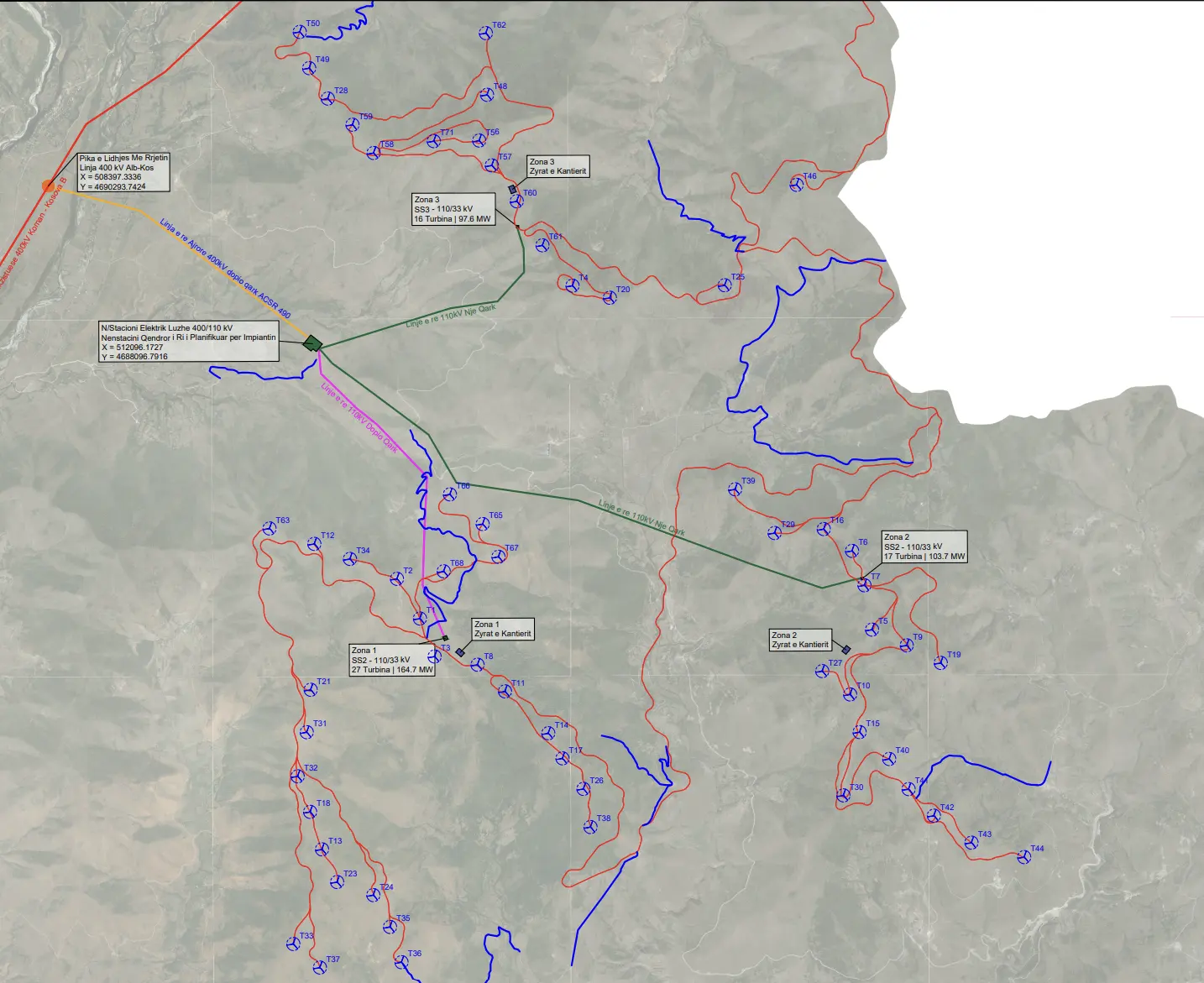
The Tropoja Wind Farm is a large-scale onshore renewable-energy project planned in the Municipality of Tropojë, Kukës County, Albania. The project is being developed by Eralb Invest 2 SH.P.K., with Blue Water Energy SH.P.K. identified in the project documentation as the consulting and technical development entity. The project is being advanced within Albania’s applicable energy, planning, environmental and permitting framework, including the procedures associated with Preliminary and Final Approval, technical review by the relevant authorities, environmental documentation and approval for connection to the national transmission system.
The reference configuration comprises approximately 366 MW of installed wind-generation capacity, based on 60 GE 6.1-158 wind turbine generators. Each turbine has a rated capacity of 6.1 MW, a rotor diameter of 158 m and a nominal hub height of 121 m. The selected turbine configuration is identified as IEC Class S and has been assessed against the mountainous terrain, wind regime, climatic conditions and transport constraints of the site. The expected net annual energy production is approximately 915 GWh/year, corresponding to an estimated net capacity factor of approximately 28.5%.
The project area is characterized by complex mountainous topography, elevated terrain and variable slopes. Wind-resource assessment has been supported by meteorological measurements at approximately 105 m, with long-term corrected wind speeds generally in the range of 6.36–6.58 m/s at the measurement locations. The development includes turbine foundations, crane platforms, internal access roads, transport corridors, electrical collection infrastructure, substations and grid-connection facilities.
The internal electrical system will collect power from the individual turbines through a medium-voltage collector network and transfer it to project substations. The principal grid interface includes a 400/110 kV AIS substation with two 200/240 MVA transformer units, together with additional 110 kV substation infrastructure. The grid-connection studies identify a high-voltage export system, including a reference 220 kV connection route and transmission-line corridors of approximately 17.11 km, with alternative corridor lengths also assessed.
Construction will require phased road and platform works, heavy-lift transport, crane assembly, tower erection, nacelle and rotor installation, electrical works, testing and commissioning. Environmental considerations include minimization of land disturbance, protection of sensitive habitats and watercourses, restoration of temporary construction areas and management of noise, traffic and waste. During operation, the wind farm will be remotely monitored and maintained through scheduled inspections, condition monitoring and corrective maintenance over its operational life.